
Chapter 5 Nonabelian Examples
Section 5.1 General Linear Groups
Recall that we defined the general linear group with entries from \(\R\) to be the set
\begin{equation*}
\operatorname{GL}_n(\R) = \left\{M \in M_n(\R) \;\middle\vert\; \det{M} \neq 0\right\}
\end{equation*}
equipped with matrix multiplication. Since matrix multiplication is noncommutative, this is an example of a multiplicative noncommutative group.
Section 5.2 Symmetric Groups
Let \(X\) be a set. Recall that we defined the symmetric group on \(X\) to be the set
\begin{equation*}
S_X = \left\{\sigma : X \to X \;\middle\vert\; \sigma\ \text{is a bijection}\right\}\text{.}
\end{equation*}
equipped with the binary operation of composition. If the set \(X\) has at least three elements, then \(S_X\) is a noncommutative group.
To see this, assume \(a\text{,}\) \(b\text{,}\) and \(c\) are distinct elements of \(X\text{.}\) Define the bijection
\begin{align*}
\sigma \colon X \amp\to X\\
x \amp\mapsto
\begin{cases}
a \amp\text{if}\ x = b,\\
b \amp\text{if}\ x = a,\\
x \amp \text{else}
\end{cases}
\end{align*}
that interchanges \(a\) and \(b\) and the bijection
\begin{align*}
\tau \colon X \amp\to X\\
x \amp\mapsto
\begin{cases}
a \amp\text{if}\ x = c,\\
c \amp\text{if}\ x = a,\\
x \amp \text{else}
\end{cases}
\end{align*}
that interchanges \(a\) and \(c\text{.}\) Observe that
\begin{equation*}
\sigma \circ \tau (a) = \sigma(c) = c
\quad\text{and}\quad
\tau \circ \sigma (a) = \tau(b) = b\text{.}
\end{equation*}
This establishes that \(\sigma \circ \tau \neq \tau \circ \sigma\text{.}\)
When \(X = \{1,2,\ldots,n\}\) for some integer \(n\text{,}\) we refer to the symmetric group on \(X\) as the symmetric group on \(n\) letters and write \(S_n\) instead of \(S_X\text{.}\) Using function notation is often cumbersome in this instance. For example, we could define an element \(\sigma\) in \(S_6\) by writing the explicit mapping on elements:
\begin{align*}
1 \amp\mapsto 3 \amp 4 \amp\mapsto 2\\
2 \amp\mapsto 4 \amp 5 \amp\mapsto 1\\
3 \amp\mapsto 5 \amp 6 \amp\mapsto 6
\end{align*}
We note that the inverse \(\sigma\) is defined by
\begin{align*}
1 \amp\mapsto 5 \amp 4 \amp\mapsto 2\\
2 \amp\mapsto 4 \amp 5 \amp\mapsto 3\\
3 \amp\mapsto 1 \amp 6 \amp\mapsto 6
\end{align*}
We could observe that \(\sigma\) and \(\sigma^{-1}\) permute subsets of elements in a cycle, called orbits.
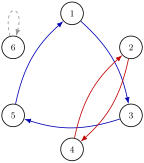
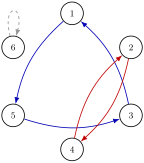
We say the orbit \(\{6\}\) is trivial because \(\sigma\) fixes \(6\text{.}\) The distinct nontrivial orbits can be used to define permutations of the set \(\{1,2,3,4,5,6\}\text{.}\) For example, the orbit \(\{1,3,5\}\) can be associated with the permutation
\begin{align*}
1 \amp\mapsto 3 \amp 4\amp\mapsto 4\\
2 \amp\mapsto 2 \amp 5 \amp\mapsto 1\\
3 \amp\mapsto 5 \amp 6 \amp\mapsto 6
\end{align*}
and the orbit \(\{2,4\}\) can be associated with the permutation
\begin{align*}
1 \amp\mapsto 1 \amp 4\amp\mapsto 2\\
2 \amp\mapsto 4 \amp 5 \amp\mapsto 5\\
3 \amp\mapsto 3 \amp 6 \amp\mapsto 6
\end{align*}
Permutations of this type are called cycles of length \(m\) in \(S_n\) (here, \(m = 3\) and \(m = 2\text{,}\) respectively). We represent the first permutation using the shorthand \((1\ 3\ 5)\) and the second using the shorthand \((2\ 4)\text{.}\) Using this shorthand, we express function evaluation as follows:
\begin{align*}
(1\ 3\ 5)(1) \amp= 3 \amp (1\ 3\ 5)(4) \amp= 4\\
(1\ 3\ 5)(2) \amp= 2 \amp (1\ 3\ 5)(5) \amp= 1\\
(1\ 3\ 5)(3) \amp= 5 \amp (1\ 3\ 5)(6) \amp= 6
\end{align*}
Cycles are especially simple elements of \(S_n\) that can be used to build the elements of \(S_n\) through composition. For example, we can decompose \(\sigma\) into the composition of the cycles \((1\ 3\ 5)\) and \((2\ 4)\text{.}\) We typically omit the \(\circ\) symbol and simply write
\begin{equation*}
\sigma = (1\ 3\ 5)(2\ 4) = (2\ 4)(1\ 3\ 5)
\end{equation*}
with the understanding that evaluation occurs from right to left:
\begin{align*}
(1\ 3\ 5)(2\ 4)(1) \amp= (1\ 3\ 5)(1) = 3 \amp (1\ 3\ 5)(2\ 4)(4) \amp= (1\ 3\ 5)(2) = 2\\
(1\ 3\ 5)(2\ 4)(2) \amp= (1\ 3\ 5)(4) = 4 \amp (1\ 3\ 5)(2\ 4)(5) \amp= (1\ 3\ 5)(5) = 1\\
(1\ 3\ 5)(2\ 4)(3) \amp= (1\ 3\ 5)(3) = 5 \amp (1\ 3\ 5)(2\ 4)(6) \amp= (1\ 3\ 5)(6) = 6
\end{align*}
We call \(\sigma = (1\ 3\ 5)(2\ 4)\) the cycle decomposition of \(\sigma\text{.}\) By adopting the convention that each cycle begins with the smallest integer on the left, we can guarantee that this representation is unique up to ordering of the cycles.
If we have another permutation, say \(\tau = (1\ 2\ 3)(4\ 5\ 6)\text{,}\) then we can compute the cycle decompositions for \(\sigma \tau\) and \(\tau \sigma\) by finding the disjoint cyclic permutations:
\begin{align*}
\sigma\tau \amp= (1\ 3\ 5)(2\ 4)(1\ 2\ 3)(4\ 5\ 6) = (1\ 4)(2\ 5\ 6)\\
\tau\sigma \amp= (1\ 2\ 3)(4\ 5\ 6)(1\ 3\ 5)(2\ 4) = (2\ 5)(3\ 6\ 4)
\end{align*}
This also provides a handy mechanism for finding the inverse of a permutation. We can invert a cycle by simply reversing the order in which we traverse the orbit: \((1\ 3\ 5)\) becomes \((5\ 3\ 1)\) and we rewrite in standard form to obtain \((1\ 5\ 3)\text{.}\) When we have the cycle decomposition of a permutation, we simply invert each of the cycles:
\begin{align*}
\sigma^{-1} \amp= (1\ 5\ 3)(2\ 4) = (2\ 4)(1\ 5\ 3)\\
\tau^{-1} \amp= (1\ 3\ 2)(4\ 6\ 5) = (4\ 6\ 5)(1\ 3\ 2)\text{.}
\end{align*}
Section 5.3 Dihedral Groups
Recall from Subsection 4.2.3 that we can inscribe a regular \(n\)-gon in the unit circle using the \(n^\text{th}\) roots of unity.


Subsection 5.3.1 Rigid Motions of the Regular \(n\)-gon
A rigid motion of the regular \(n\)-gon is any relabeling of the vertices that preserves vertex adjacencies. Since the relabeling must preserve the adjacencies, it is enough to determine which vertex is labelled \(1\) and how to label its two adjacent vertices. Once these two choices are made, the locations of the remaining vertices are uniquely determined.
To count the number of rigid motions of the regular \(n\)-gon, it is enough to observe that there are precisely two ways to label the adjacent vertices:


The first labeling preserves the orientation of the \(n\)-gon that we chose in the construction, while the second reverses the orientation. This tells us that there are \(n\) choices for which vertex is labelled \(1\text{,}\) and two choices of orientation of the object. Therefore there are \(2n\) total rigid motions of the regular \(n\)-gon. The simplest of these rigid motions is the "trivial" rigid motion.
Subsection 5.3.2 Rotations
If we regard the \(n\)-gon as a physical object, the kind of relabeling that preserves the orientation corresponds to a rotation of the regular \(n\)-gon.
Definition 5.6.
The rotation \(r\) is the rigid motion of the regular \(n\)-gon obtained by rotating counter-clockwise so that vertex \(i\) is moved to the position of vertex \(i+1\) for \(1 \leq i \lt n\) and vertex \(n\) is moved to the position of vertex \(1\text{.}\)
We write \(r^i\) to mean the regular \(n\)-gon has been rotated \(i\) times in the counter-clockwise direction.
Example 5.7. Rotations of the Regular \(4\)-gon.
The regular \(4\)-gon has three distinct vertex labellings obtained by rotation and are pictured below. The first is the single counter-clockwise rotation \(r\text{.}\)


The rotation \(r^3\) rotates the regular \(4\)-gon three times to obtain the following configuration.

If we rotate counter-clockwise again, then we return to the original configuration. That is to say, \(r^4 = 1\text{.}\)
Remark 5.11.
Note that while we choose to rotate in the direction of the labelling, this choice is superficial. If, instead, we had chosen to rotate clockwise, then we would achieve the exact same configurations, albeit in a different order.


In particular, we observe that clockwise rotation yields the same configuration as \(r^3\text{.}\) Since rotating counter-clockwise then clockwise or clockwise then counter-clockwise produce the same rigid motion as \(1\text{,}\) this leads us to relation \(r^{-1} = r^3\)
In general, the regular \(n\)-gon has a total of \(n-1\) non-trivial rigid motions given by rotation,
\begin{equation*}
r, r^2, r^3, \ldots, r^{n-1}.
\end{equation*}
The rotation \(r\) satisfies \(r^n = 1\) and \(r^{-1} = r^{n-1}\text{.}\) We interpret the latter relation as saying rotating once in the clockwise direction is equivalent to rotating \(n-1\) times in the counter-clockwise direction and vise-versa. Paired with the former relation, we see for each \(1 \leq i \lt n\) the rotation \(r^i\) is invertible with inverse \(r^{-i} = r^{n-i}\text{.}\)
Subsection 5.3.3 Reflections
The second kind of relabeling is obtained by flipping the \(n\)-gon over. In order to perform this operation, we require the lines of symmetry of the regular \(n\)-gon. We call each rigid motion of this type a reflection of the regular \(n\)-gon. In general, the regular \(n\)-gon has \(n\) lines of symmetry that correspond to \(n\) reflections of the regular \(n\)-gon. However, it is worth noting that the location of these lines of symmetry depends on whether \(n\) is odd or even.
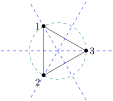
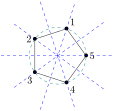
When \(n\) is an odd integer, the lines of symmetry of the regular \(n\)-gon are obtained by drawing a line through the center and each vertex. For example, when \(n = 3\) we obtain the equilateral triangle and when \(n = 5\text{,}\) we obtain the regular pentagon. Their lines of symmetry are depicted in Figure 5.13.
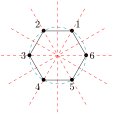
When \(n\) is an even integer, the lines of symmetry of the regular \(n\)-gon are obtained by drawing a line through the center and each vertex, as well as the lines through the center that bisect each edge. For example, when \(n = 4\) we obtain the square and when \(n = 6\text{,}\) we obtain the regular hexagon. Their lines of symmetry are depicted in Figure 5.14.

Example 5.15. Reflections of the regular \(4\)-gon.
Consider the regular \(4\)-gon, which has exactly four reflections. First we consider the reflection, \(s\text{,}\) obtained from the line through the vertices \(2\) and \(4\text{.}\) This reflection fixes vertices \(2\) and \(4\text{,}\) and interchanges vertices \(1\) and \(3\text{,}\) which is depicted in Figure 5.16.
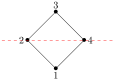
Note that the reflection \(s\) is its own inverse. If we flip the object over the same line of symmetry a second time, the vertices \(1\) and \(3\) are again interchanged. The resulting vertex labelling is the original configuration of the regular \(4\)-gon. That is to say \(s^2 = 1\text{.}\)
Next, we consider the line at a 45 degree angle through the center. This line of symmetry bisects the edge connecting vertex 1 to vertex 4, and the edge connecting vertex 2 to vertex 3. The reflection obtained by flipping the regular \(4\)-gon over this line of symmetry interchanges these two pairs of vertices as depicted in Figure 5.17.

It is worth noting that this configuration can also be obtained from Figure 5.16 by rotating once counter-clockwise. We represent this reflection as \(rs\) that, akin to function notation, tells us to first apply the reflection \(s\text{,}\) then apply the rotation \(r\text{.}\) As with the reflection \(s\text{,}\) we note that \((rs)^2 = 1\text{.}\)
Working counter-clockwise, the next line of symmetry is the line at a 90 degree angle through the center. This line passes through vertices \(1\) and \(3\text{,}\) so the reflection obtained by flipping the regular \(4\)-gon over this line of symmetry will fix these two vertices and interchange vertices \(2\) and \(4\) as depicted in Figure 5.18.
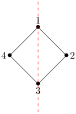
Again, we observe this configuration can be obtained from Figure 5.17 by a single counter-clockwise rotation or from Figure 5.16 by two counter-clockwise rotations. As such, we represent this reflection as \(r^2s\) and again note that \(\left(r^2s\right)^2 = 1\text{.}\)
Finally, we consider the line of symmetry through the center at a \(135\) degree angle. Similar to the reflection \(s\text{,}\) this reflection interchanges the vertex pairs on the bisected edges, as depicted in Figure 5.18.

Again, we observe this configuration can be obtained from Figure 5.18 by a single counter-clockwise rotation, from Figure 5.17 by two counter-clockwise rotations, and from Figure 5.16 by three counter-clockwise rotations. As such, we represent this reflection as \(r^3s\) and note that \(\left(r^3s\right)^2 = 1\text{.}\)
Remark 5.20.
It is worth noting that, as with the rotations, the choice of which reflection we label \(s\) is superficial. For example, if we had chosen \(s\) to be the reflection depicted in Figure 5.18, then the reflection depicted in Figure 5.16 would be \(r^2s\text{,}\) the reflection depicted in Figure 5.17 would be \(r^3s\text{,}\) and the reflection depicted in Figure 5.19 would be \(rs\text{.}\)
Definition 5.21.
The reflection \(s\) of the regular \(n\)-gon is the rigid motion obtained by flipping the regular \(n\)-gon over the line of symmetry through vertex \(n\text{.}\)
As observed in Example 5.15, the \(n\) reflections of the regular \(n\)-gon are obtained by combining a reflection with a rotation
\begin{equation*}
s, rs, r^2s, r^3s, \ldots, r^{n-1}s.
\end{equation*}
One advantage of constructing the regular \(n\)-gon by inscribing it in the unit circle is that it makes describing the reflection \(s\) simple.
-
When \(n = 2k\text{,}\) \(s\) fixes the vertices labelled \(n\) and \(k\) and interchanges the positions of vertex \(i\) and vertex \(n-i\text{,}\) for \(i = 1, 2, \ldots, k-1\text{.}\)
-
When \(n = 2k + 1\text{,}\) \(s\) fixes only the vertex labelled \(n\) and interchanges the positions of vertex \(i\) and vertex \(n-i\) for \(i = 1, 2, \ldots, k-1\text{.}\)
That is to say, the reflection \(s\) swaps the positions of two vertices \(i\) and \(j\) if and only if \(i + j = n\text{.}\) There are \(k-1 = (n-2)/2\) such pairings when \(n = 2k\) and \(k-1 = (n-1)/2\) such pairings when \(n = 2k + 1\text{.}\)
Subsection 5.3.4 Commutation Relation
We have observed that each symmetry of the regular \(n\)-gon can be obtained as \(r^is^j\) for some \(0 \leq i \lt n\) and \(0 \leq j \leq 1\text{.}\) This tells us that we can obtain every rigid motion of the regular \(n\)-gon as some combination rotations and reflections. We are naturally lead to ask the following question.
Question 5.22.
For a regular \(n\)-gon, does the order in which we perform rotations and reflections matter?
In general, the answer to this question is yes. Since every rigid motion can be written in the form \(r^is^j\text{,}\) it is enough to understand the relationship between the reflection \(rs\) and the reflection \(sr\) for the regular \(n\)-gon. Let \(k = n/2\) for \(n\) even or \(k = (n-1)/2\) for \(n\) odd. The reflection \(s\) interchanges vertex \(i\) and vertex \(n-i\) for each \(1 \leq i \lt k\text{.}\) Starting from the vertex at the point \((1,0)\) and reading counter-clockwise, this results in the vertices being labelled \(n, n-1, n-2, \ldots, 2, 1\text{.}\) Applying the rotation \(r\) cycles this vertex labelling to
\begin{equation*}
1,n,n-1, \ldots 3, 2\text{,}
\end{equation*}
where the labels are read counter-clockwise starting from the point \((1,0)\text{.}\)
On the other hand, if we first apply the rotation \(r\text{,}\) then the labelling read counter-clockwise from the vertex at \((1,0)\) is \(n-1, n, 1, 2, \ldots, n-2\text{.}\) The reflection \(s\) now interchanges the \(k-1\) pairs of vertices that sum not to \(n\) but to \(n+2\text{.}\) This results in the labelling
\begin{equation*}
n-1, n-2, n-3, \ldots, 1, n
\end{equation*}
read counter-clockwise from the vertex at \((1,0)\text{.}\) Recognizing this as the result of applying one clockwise rotation to the vertex labelling
\begin{equation*}
n, n-1, n-2, \ldots, 2, 1
\end{equation*}
obtained by applying \(s\text{,}\) we can see that
\begin{equation*}
sr = r^{-1}s = r^{n-1}s.
\end{equation*}
Subsection 5.3.5 Group Structure
The commutation relation \(sr = r^{-1}s\) allows us to rewrite
\begin{equation*}
sr^i = s\underbrace{r r \cdots r}_i = \underbrace{r^{-1}r^{-1} \cdots r^{-1}}_i s = r^{-i}s = r^{n-i}s
\end{equation*}
for any \(i \in \{1,2,\ldots,n-1\}\text{.}\) This culminates in the following definition.
Definition 5.23.
The Dihedral Group with \(2n\) elements is the set of rigid motions of the regular \(n\)-gon
\begin{equation*}
D_{2n} = \left\{1, r, r^2, \ldots, r^{n-1}, s, rs, r^2s, \ldots, r^{n-1}s\right\}
\end{equation*}
under the operation of composition of rigid motions.
Remark 5.24.
The notation for the dihedral group is not standardized. Some mathematicians adopt the convention, as we do, that the subscript indicates the number of elements in the dihedral group. For example, \(D_8\) is the group consisting of the eight rigid symmetries of the square.
Confusingly, other mathematicians adopt the convention that the subscript indicates the number of vertices on the regular polygon. For example, by this convention, \(D_8\) is the group of sixteen rigid symmetries of the octagon.
Exercises 5.4 Exercises for Undergrads & Grads
Working with Permutations.
Define the permutation \(\sigma \in S_{10}\) by
\begin{align*}
1 \amp\mapsto 3 \amp 2 \amp\mapsto 8 \amp 3 \amp\mapsto 5 \amp 4 \amp\mapsto 6 \amp 5 \amp\mapsto 7\\
6 \amp\mapsto 9 \amp 7 \amp\mapsto 1 \amp 8 \amp\mapsto 2 \amp 9 \amp\mapsto 10 \amp 10 \amp\mapsto 4
\end{align*}
and the permutation \(\tau \in S_{10}\) by
\begin{align*}
1 \amp\mapsto 2 \amp 2 \amp\mapsto 4 \amp 3 \amp\mapsto 6 \amp 4 \amp\mapsto 1 \amp 5 \amp\mapsto 5\\
6 \amp\mapsto 9 \amp 7 \amp\mapsto 7 \amp 8 \amp\mapsto 8 \amp 9 \amp\mapsto 10 \amp 10 \amp\mapsto 3
\end{align*}
1.
Compute the cycle decomposition for \(\sigma\text{.}\)
2.
Compute the cycle decomposition for \(\tau\text{.}\)
3.
Compute the cycle decomposition for \(\sigma\tau\)
4.
Compute the cycle decomposition for \(\tau\sigma\)

