Logo image

Chapter 4 Abelian Examples

Section 4.1 The Integers Modulo \(n\)

A common way to construct groups from known examples is to utilize a "well-behaved" equivalence relation and endow the set of equivalence classes, called the quotient by an equivalence relation, with a group structure. We will delve into the general theory when we cover quotient groups. For now, we simply fix an integer \(n\) and define the relation on \(\Z\) by
\begin{equation*} a \equiv b \pmod{n} \iff \exists k \in \Z, -a + b = kn\text{,} \end{equation*}
read β€œ\(a\) is congruent to \(b\) modulo \(n\)”.
It is a good exercise to check that this defines an equivalence relationβ€”that is, equivalence modulo \(n\) is reflexive, symmetric, and transitive. The equivalence classes of this relation are called the residue classes modulo \(n\). We can interpret \(a \equiv b \pmod{n}\) as expressing that \(a\) and \(b\) have the same remainder when divided by \(n\text{.}\) Indeed, we can find a representative for an equivalence class by observing the process of long division produces two integers \(q\text{,}\) called the quotient, and \(0 \leq r \lt n\text{,}\) called the remainder (see AppendixΒ A), that satisfy
\begin{align*} \frac{a}{n} = q + \frac{r}{n} \amp\iff a = qn + r\\ \amp\iff a - r = qn \\ \amp\iff -r + a = qn\\ \amp\iff r \equiv a \pmod{n}\\ \amp\iff a \equiv r \pmod{n}\text{.} \end{align*}
That is to say, every residue class is represented by one of \(0, 1, \ldots, n-1\text{.}\)
We denote the residue class of \(a\) modulo \(n\) by \(\overline{a}\text{.}\) With this notation, the set of residue classes modulo \(n\) is
\begin{equation*} \Z/n\Z = \left\{\overline{0}, \overline{1}, \ldots, \overline{n-1}\right\}\text{.} \end{equation*}
We equip this with set with the binary operation
\begin{equation*} \overline{a} + \overline{b} = \overline{a + b} \end{equation*}
and claim this defines an additive abelian group.

Proof.

We must prove that the addition is independent of the representation. That is to say, for all \(a \equiv c \pmod{n}\) and \(b \equiv d \pmod{n}\text{,}\) \(\overline{a+b} = \overline{c+d}\text{.}\) By definition, there exist \(k_1,k_2 \in \Z\) such that
\begin{equation*} -a + c = k_1 n \quad\text{and}\quad -b + d = k_2n\text{.} \end{equation*}
Hence
\begin{equation*} -(a + b) + (c + d) = \left(-a + c\right) + \left(- b + d\right) = k_1n + k_2n = (k_1 + k_2)n \end{equation*}
implies \(\overline{a+b} = \overline{c + d}\text{.}\) Hence \(+\) is a well-defined binary operation on \(\Z/n\Z\text{.}\)
For the final claim, we observe that
\begin{equation*} \overline{a} + \overline{b} = \overline{a+b} = \overline{b+a} = \overline{b} + \overline{a} \end{equation*}
because addition of integers is commutative. Therefore \(+\) is a well-defined commutative, binary operation on \(\Z/n\Z\text{.}\)

Proof.

We must verify each of the axioms. First, we show that associativity of addition on \(\Z\) implies addition on \(\Z/n\Z\) is also associative. Towards that end, let \(\overline{a}, \overline{b}, \overline{c} \in \Z/n\Z\) be given. Using the definition of \(+\) and associativity of addition on \(\Z\)
\begin{align*} \overline{a} + \left(\overline{b} + \overline{c}\right) \amp= \overline{a} + \overline{b + c}\\ \amp= \overline{a + (b + c)}\\ \amp= \overline{(a + b) + c}\\ \amp= \overline{a + b} + \overline{c}\\ \amp= \left(\overline{a} + \overline{b}\right) + \overline{c} \end{align*}
Hence \((\Z/n\Z,+)\) is a semigroup.
Next, we observe that \(\overline{0}\) is the additive identity because for all \(\overline{a} \in \Z/n\Z\text{,}\)
\begin{equation*} \overline{a} + \overline{0} = \overline{a + 0} = \overline{a} = \overline{0 + a} = \overline{0} + \overline{a}\text{.} \end{equation*}
Hence \((\Z/n\Z,+)\) is a monoid.
Now we show that every element has an additive inverse. Given \(\overline{a} \in \Z/n\Z\text{,}\) define \(-\overline{a} = \overline{-a}\) and observe that
\begin{equation*} \overline{a} + \overline{-a} = \overline{a + -a} = \overline{0} = \overline{-a + a} = \overline{-a} + \overline{a}\text{.} \end{equation*}
Therefore \((\Z/n\Z,+)\) is an abelian group.

Section 4.2 Groups of Complex Numbers

Subsection 4.2.1 Multiplicative Group of Complex Units

Define a binary operation on \(\C = \left\{a + ib \;\middle\vert\; a,b \in \R\right\}\) by
\begin{equation*} (a+ib)(c+id) = (ac -bd) + i(ad + bc)\text{.} \end{equation*}
We leave the proof that this defines a group structure on
\begin{equation*} \C^\times = \C \setminus\{0\} = \left\{a + ib \in \C \;\middle\vert\; a \neq 0\ \text{or}\ b \neq 0\right\} \end{equation*}
as an exercise.

Subsection 4.2.2 Unit Circle Group

Recall that
\begin{equation*} \left\{(a,b) \;\middle\vert\; a^2 + b^2 = 1\right\} \end{equation*}
is the unit circle in \(\R^2\text{.}\) We can regard points in the plane as complex numbers by the identification \((a,b) \leftrightarrow a + ib\text{.}\) Under this identification,
\begin{equation*} U = \left\{a + ib \;\middle\vert\; \lvert a + ib\rvert\right\} \subseteq \C \end{equation*}
represents the unit circle in the plane. We leave the proof that this forms a multiplicative abelian group as an exercise.

Subsection 4.2.3 The \(n^\text{th}\) Roots of Unity

For every \(n \in \N\text{,}\) we can consider the polynomial \(x^n - 1\text{.}\) Over \(\R\text{,}\) this polynomial has exactly one real root, \(x = 1\text{,}\) when \(n\) is odd and two real roots, \(x = \pm 1\text{,}\) when \(n\) is even. However, over \(\C\text{,}\) every polynomial of degree \(n\) has exactly \(n\) roots, counting multiplicity (this result is known as the Fundamental Theorem of Algebra
 1 
en.wikipedia.org/wiki/Fundamental_theorem_of_algebra
). The roots of this polynomial are called the \(n^\text{th}\) roots of unity and denoted by \(U_n\text{.}\)
The notation \(U_n\) is indeed suggestive, as every root of unity lies on the unit circle. If \(\zeta \in U_n\text{,}\) then
\begin{equation*} 1 = \lvert \zeta^n \rvert = \lvert \zeta \rvert^n \end{equation*}
implies \(\zeta = 1\) because it is the only non-negative real \(n^\text{th}\) root of unity. We can pinpoint these roots of unity precisely using a result named after Abraham De Moivre which states
\begin{equation*} \left(\cos(\theta) + i\sin(\theta)\right)^n = \cos(n\theta) + i\sin(n\theta)\text{.} \end{equation*}
The connection between De Moivre’s Theorem and roots of unity is polar coordinates.
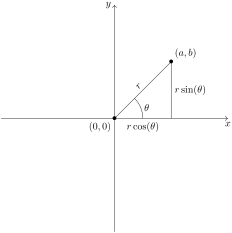
Given a point \((a,b) \in \R^2\text{,}\) write \(r = \sqrt{a^2+b^2}\) and use polar coordinates to obtain the following triangle.
Using the identification \((a,b) \leftrightarrow a + ib\text{,}\) we can express any complex number \(a + ib\) in the form
\begin{equation*} r\left(\cos(\theta) + i\sin(\theta)\right)\text{.} \end{equation*}
Together with De Moivre’s Theorem, we see the complex roots of \(x^n - 1\) are precisely the points of the form \(\cos(\theta) + i \sin(\theta)\) that satisfy
\begin{equation*} \cos(n\theta) + i\sin(n\theta) = 1 + i0\text{,} \end{equation*}
from which we deduce that \(\cos(n\theta) = 1\) and \(\sin(n\theta) = 0\text{.}\) A quick glance at the unit circle tells us this occurs only when \(n\theta\) is a multiple of \(2\pi\text{.}\)
If we take the simplest solution, \(\theta = 2\pi/n\text{,}\) then we observe that for any integer \(a\text{,}\)
\begin{align*} \cos\left(n(a\theta)\right) \amp= \cos\left(a2\pi\right) = 1,\,\text{and}\\ \sin\left(n(a\theta)\right) \amp= \sin\left(a2\pi\right) = 0\text{.} \end{align*}
This tells us the points on the unit circle corresponding to the angles
\begin{equation*} 0, \frac{2\pi}{n}, 2\left(\frac{2\pi}{n}\right), \ldots, (n-1)\left(\frac{2\pi}{n}\right) \end{equation*}
are \(n\) distinct roots of \(x^n - 1\text{.}\) Since we know there exist at most \(n\) roots, having found \(n\) roots tells us these are all the roots of unity.
We note that the roots of unity divide the unit circle into \(n\) equal pieces and can be used to inscribe a regular \(n\)-gon in the circle.
Figure 4.3. The hexagon formed by the sixth roots of unity.
Moreover, the roots of unity form a multiplicative abelian group. In order to prove this, it is useful to adopt notation from Euler,
\begin{equation*} re^{i\theta} := r\cos(\theta) + ir\sin(\theta)\text{,} \end{equation*}
known as Euler’s Formula. Relying on the identities for \(\cos(\theta \pm \phi)\) and \(\sin(\theta \pm \phi)\text{,}\) it is simple (albeit tedious) to show that

\begin{equation*} (r_1e^{i\theta})(r_2e^{i\phi}) = (r_1r_2)e^{i(\theta + \phi)}\text{.} \end{equation*}
We leave it as an exercise for the reader to that \(U_n\) is indeed a group.