Logo image

Chapter 11 Factor Groups

Section 11.1 Normal Subgroups

Definition 11.1. Normal Subgroup.

Let \(G\) be a group. We say \(N \leq G\) is normal in \(G\) (or a normal subgroup of \(G\)) if for all \(a,b \in G\text{,}\)
\begin{equation*} a \equiv_\ell b \pmod{N} \iff a \equiv_r b \pmod{N}\text{.} \end{equation*}
We write \(N \unlhd G\) to denote that \(N\) is a normal subgroup of \(G\text{.}\)

Proof.

Assume that for all \(a,b \in G\text{,}\)
\begin{equation*} a \equiv_\ell b \pmod{N} \iff a \equiv_r b \pmod{N}\text{.} \end{equation*}
Let \(a \in G\) be given. For all \(g \in G\text{,}\)
\begin{align*} g \in aN \amp\iff g \equiv_\ell a \pmod{N}\\ \amp\iff g \equiv_r a \pmod{N}\\ \amp\iff g \in Na\text{.} \end{align*}
Hence for all \(a \in G\text{,}\) \(aN = Na\text{.}\)
Assume for all \(g \in G\text{,}\) \(gN = Ng\text{.}\) To show that \(G/N\) is a group, we must first prove that the binary operation is independent of the chosen representative. Let \(a,b,c,d \in G\) be given. Suppose \(a \equiv_\ell c \pmod{N} \iff a^{-1}c \in N\) and \(b \equiv_\ell d \pmod{N} \iff b^{-1}d \in N\text{.}\) Since \(dN = Nd\text{,}\) there exists \(n \in N\) such that \((a^{-1}c)d = dn\) and thus
\begin{equation*} (ab)^{-1}cd = b^{-1}\left(a^{-1}c\right)d = \left(b^{-1}d\right)n \in N\text{.} \end{equation*}
Hence \(ab \equiv cd \pmod{N} \iff (ab)N = (cd)N\text{.}\) This establishes that the binary operation is well-defined.
Associativity, identity, and inverses for this binary operation are inherited from the binary operation on \(G\text{.}\)
Associativity
For all \(a,b,c \in G\text{,}\)
\begin{align*} (aNbN)cN \amp= (ab)NcN\\ \amp= ((ab)c)N\\ \amp= (a(bc))N\\ \amp = aN(bc)N\\ \amp= aN(bNcN) \end{align*}
Identity
For all \(g \in G\text{,}\)
\begin{align*} (1N)(gN) \amp = (1g)N\\ \amp = gN\\ \amp = (g1)N\\ \amp = (gN)(1N) \end{align*}
implies \(1N = 1_{G/N}\text{.}\)
Inverses
For all \(g \in G\text{,}\)
\begin{align*} (gN)(g^{-1}N) \amp = (gg^{-1})N\\ \amp = 1N\\ \amp = (g^{-1}g)N\\ \amp = (g^{-1}N)(gN) \end{align*}
implies that \((gN)^{-1} = (g^{-1}N)\text{.}\)
Hence if for all \(g \in G\text{,}\) \(gN = Ng\text{,}\) then \(G/N\) is a group under the binary operation \((aN)(bN) = (ab)N\text{.}\)
Assume \(G/N\) is a group under the binary operation \((aN)(bN) = (ab)N\text{.}\) For all \(a,b \in G\text{,}\) the Canonical Projection to the Quotient, \(\pi \colon G \to G/N\) satisfies
\begin{equation*} \pi(ab) = (ab)N = (aN)(bN) = \pi(a) \pi(b) \end{equation*}
by definition of the binary operation on \(G/N\text{,}\) and thus \(\pi\) is a morphism of groups. For all \(a \in G\text{,}\)
\begin{align*} a \in \ker{\pi} \amp\iff aN = \pi(a) = 1N\\ \amp\iff a \equiv_\ell 1 \pmod{N}\\ \amp\iff a \in 1N = N\text{.} \end{align*}
Hence if \(G/N\) is a group, then \(\pi \colon G \to G/N\) is a morphism of groups and \(N\) is the kernel of \(\pi\text{.}\)
Assume there exists a morphism of groups \(\phi \colon G \to H\) such that \(N = \ker{\phi}\text{.}\) Let \(g \in G\) be given. For all \(n \in N\text{,}\)
\begin{equation*} \phi\left(gng^{-1}\right) = \phi(g)\phi(n)\phi(g)^{-1} = \phi(g)\phi(g)^{-1} = 1 \end{equation*}
implies \(gng^{-1} \in N\text{.}\) Hence if there exists a morphism of groups \(\phi \colon G \to H\) such that \(N = \ker{\phi}\text{,}\) then for all \(g \in G\text{,}\) \(gNg^{-1} \subseteq N\text{.}\)
Assume for all \(g \in G\text{,}\) \(gNg^{-1} \subseteq N\text{.}\) Let \(n \in N\) be given. By assumption,
\begin{equation*} g^{-1}ng \in g^{-1}N\left(g^{-1}\right)^{-1} = g^{-1}Ng \subseteq N \end{equation*}
and thus
\begin{equation*} n = \left(gg^{-1}\right)n\left(gg^{-1}\right) = g\left(g^{-1}ng\right)g^{-1} \in gNg^{-1}\text{.} \end{equation*}
Hence if for all \(g \in G\text{,}\) \(gNg^{-1} \subseteq N\text{,}\) then for all \(g \in G\text{,}\) \(gNg^{-1} = N\text{.}\)
Assume for all \(g \in G\text{,}\) \(gNg^{-1} = N\text{.}\) Let \(a,b \in G\) be given. First we observe that for all \(g \in G\text{,}\) \(g \in N\) if and only if \(aga^{-1} \in N\text{.}\) The forward direction holds by assumption, while the converse holds because \(aga^{-1} \in N\) implies
\begin{equation*} g = a^{-1}\left(aga^{-1}\right)a \in a^{-1}Na = N \end{equation*}
Then
\begin{align*} a \equiv_\ell b \pmod{N} \amp\iff a^{-1}b \in N\\ \amp\iff a\left(a^{-1}b\right)a^{-1} \in N\\ \amp\iff ba^{-1} \in N\\ \amp\iff b \equiv_r a \pmod{N}\\ \amp\iff a \equiv_r \pmod{N} \end{align*}
Hence if for all \(g \in G\text{,}\) \(gNg^{-1} = N\text{,}\) then \(N \unlhd G\text{.}\)

Proof.

Assume \(A\) is abelian and \(B \leq A\text{.}\) Let \(a \in A\) be given. For all \(b \in B\text{,}\)
\begin{equation*} aba^{-1} = aa^{-1}b = b \end{equation*}
implies
\begin{equation*} aBa^{-1} = \left\{aba^{-1} \;\middle\vert\; b \in B\right\} = B\text{.} \end{equation*}
Therefore \(B \unlhd A\) by TheoremΒ 11.2.

Example 11.4. Special Linear Group.

The determinant is a morphism from the general linear group, \(\operatorname{GL}_n(\F)\text{,}\) to the multiplicative group \(\R^\times\) because
\begin{equation*} \det{MN} = \det{M}\det{N}\text{.} \end{equation*}
The kernel of this morphism is the normal subgroup
\begin{equation*} \operatorname{SL}_n(\F) = \left\{M \in \operatorname{GL}_n(\F) \;\middle\vert\; \det{M} = 1\right\}\text{.} \end{equation*}

Example 11.5.

It is important to note that not every subgroup is normal. For example, consider the dihedral group with eight elements, \(D_8 = \{1, r, r^2, r^3, s, rs, r^2s, r^3s\}\text{.}\) The subgroup \(\langle s \rangle = \{1,s\}\) is not normal in \(D_8\) because
\begin{equation*} rsr^{-1} = rsr^3 = r\left(rs\right) = r^2s \not \in \langle s \rangle = \{1,s\rangle\}\text{.} \end{equation*}

Proof.

Let \(n \in N\) and \(g \in G\) be given. Since \(N\) is normal, \(gng^{-1} \in N\) by TheoremΒ 11.2. Hence
\begin{equation*} \phi(g)\phi(n)\phi(g)^{-1} = \phi(g)\phi(n)\phi\left(g^{-1}\right) = \phi\left(gng^{-1}\right) \in \phi(N) \end{equation*}
by LemmaΒ 6.11. Therefore \(\phi(N) \unlhd \phi(G)\) by TheoremΒ 11.2.

Remark 11.7.

Note that the image of a normal subgroup is not necessarily normal in the codomain. Consider the map
\begin{align*} \phi \colon \Z \amp\to D_8\\ x \amp\mapsto s^x \end{align*}
For all \(a,b \in \Z\text{,}\)
\begin{equation*} \phi(a + b) = s^{a+b} = s^as^b = \phi(a)\phi(b) \end{equation*}
by TheoremΒ 7.6. Hence \(\phi\) is a homomorphism that satisfies
\begin{equation*} \phi(x) = \begin{cases} 1 \amp \text{if}\ x\ \text{is even},\\ s \amp \text{if}\ x\ \text{is odd} \end{cases} \end{equation*}
The image of \(\Z\) under \(\phi\) is \(\phi(\Z) = \{1,s\} = \langle s \rangle\text{.}\) However, we have already seen this is not a normal subgroup of \(D_8\) in ExampleΒ 11.5. Hence \(\Z\) is a (trivially) normal subgroup of \(\Z\) and \(\phi(\Z)\) is not normal in \(D_8\text{.}\)

Section 11.2 Inner Automorphisms

Proof.

Let \(g \in G\) be given. It suffices to observe that for all \(x_1, x_2, \in G\text{,}\)
\begin{equation*} \iota(g)(x_1x_2) = g\left(x_1x_2\right)g^{-1} = gx_1g^{-1}gx_2g^{-1} = \iota(g)(x_1)\iota(g)(x_2) \end{equation*}
and for all \(x \in G\text{,}\)
\begin{align*} \iota(g) \circ \iota\left(g^{-1}\right)(x) \amp= g\left(g^{-1}xg\right)g^{-1} = x,\\ \iota\left(g^{-1}\right) \circ \iota(g)(x) \amp= g^{-1}\left(gxg^{-1}\right)g = x \end{align*}

Definition 11.9. Inner Automorphisms.

Assume \(G\) is a group. For every \(g \in G\text{,}\) the automorphism \(\iota(g) : G \to G\) is called an inner automorphism of \(G\text{.}\) The action of forming \(gxg^{-1}\) is called conjugation of \(x\) by \(g\).

Remark 11.10.

Note that a subgroup, \(N\text{,}\) of a group, \(G\text{,}\) is normal in \(G\) if and only if for all \(g \in G\text{,}\) \(N\) is invariant under conjugation by \(g\text{.}\) That is to say, for all \(g \in G\text{,}\)
\begin{equation*} \iota(g)(N) = gNg^{-1} = N\text{.} \end{equation*}

Section 11.3 Quotient Groups

Definition 11.11. Quotient Group.

Assume \(G\) is a group and \(N \unlhd G\text{.}\) The group \(G/N\text{,}\) read \(G\) modulo \(N\text{,}\) is called the quotient of \(G\) by \(N\).

Example 11.12.

The additive group of integers is cyclic. Every subgroup of \(\Z\) has the form
\begin{equation*} n\Z = \langle n \rangle = \left\{n k \;\middle\vert\; k \in \Z\right\} \end{equation*}
and is normal because cyclic groups are abelian. The cosets of \(n\Z\) are the equivalence classes modulo \(n\)
\begin{equation*} a + n\Z = \left\{a + nk \;\middle\vert\; k \in \Z\right\} = \overline{a}\text{,} \end{equation*}
the quotient by \(n\Z\) is the familiar group of integers modulo \(n\text{,}\)
\begin{equation*} \Z/n\Z = \left\{a + n\Z \;\middle\vert\; a \in \Z\right\} = \left\{\overline{0}, \overline{1}, \ldots, \overline{n-1}\right\}\text{,} \end{equation*}
and the canonical projection \(\pi \colon \Z \to \Z/n\Z\) is the reduction modulo \(n\) morphism
\begin{equation*} \pi(ab) = \overline{ab} = \overline{a} \overline{b} = \pi(a)\pi(b)\text{.} \end{equation*}

Section 11.4 Mapping Properties of the Quotient

Proof.

Assume \(G\) is a group and \(N \unlhd G\text{.}\) Suppose \(\phi \colon G \to H\) is a morphism of groups and for all \(n \in N\text{,}\) \(\phi(n) = 1\text{.}\) Define the morphism of sets
\begin{align*} \overline{\phi} \colon G/N \amp\to H\\ xN \amp\mapsto \phi(x)\text{.} \end{align*}
This is well-defined because
\begin{align*} x_1N = x_2N \amp\iff x_1^{-1}x_2 \in N\\ \amp\implies \phi\left(x_1^{-1}x_2\right) = \phi(x_1)^{-1}\phi(x_2) = 1\\ \amp\iff \phi(x_1) = \phi(x_1)\\ \amp\iff \overline{\phi}(x_1N) = \overline{\phi}(x_2N)\text{,} \end{align*}
is a homomorphism because
\begin{align*} \overline{\phi}\left(\left(x_1N\right)\left(x_2N\right)\right) \amp= \overline{\phi}\left(\left(x_1x_2\right)N\right)\\ \amp= \phi(x_1x_2)\\ \amp= \phi(x_1)\phi(x_2)\\ \amp= \overline{\phi}(x_1N)\overline{\phi}(x_2N)\text{,} \end{align*}
and satisfies the condition for all \(x \in G\text{,}\)
\begin{equation*} \phi(x) = \overline{\phi}(xN) = \overline{\phi} \circ \pi(x)\text{.} \end{equation*}
Assume \(\psi \colon G/N \to H\) is another morphism of groups that satisfies the condition
\begin{equation*} \phi = \psi \circ \pi\text{.} \end{equation*}
For all \(xN \in G/N\text{,}\)
\begin{equation*} \psi(xN) = \psi \circ \pi(x) = \phi(x) = \overline{\phi} \circ \pi(x) = \overline{\phi}(xN)\text{.} \end{equation*}
Therefore the induced morphism \(\overline{\phi} \colon G/N \to H\) is unique.

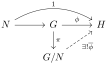
Remark 11.15.

The diagram for the quotient looks like the diagram for the Universal Property of Kernels with the arrows turned around. We say the quotient is dual to the kernel. If the universal property can be obtained as the dual, it is customary to prefix the original object’s name with β€œco”. For example, the dual of a kernel is a cokernel, which is a more modern term for the quotient.

Proof.

Assume \(\phi \colon G \to H\) is a morphism of groups and \(K = \ker{\phi}\text{.}\) For all \(k \in K\text{,}\) \(\phi(k) = 1\text{.}\) Hence by the universal mapping property, there exists a unique morphism \(\overline{\phi} \colon G/K \to H\) such that \(\overline{\phi} \circ \pi = \phi\text{.}\)
Observe that \(\overline{\phi}\) is injective because
\begin{equation*} \overline{\phi}(xK) = \phi(x) = 1 \iff x \in K \iff xK = 1K \end{equation*}
and satisfies
\begin{equation*} \overline{\phi}(G/K) = \overline{\phi}\left(\pi(G)\right) = \phi(G)\text{.} \end{equation*}
Hence \(\overline{\phi}\) is a surjection onto \(\phi(G)\text{.}\) Therefore \(G/K \cong \phi(G)\text{.}\) The final statement follows from the fact that \(\phi\) is surjective if and only if \(\phi(G) = H\text{.}\)

Exercises 11.5 Exercises for Undergrads & Grads

1.

Let \(\phi \colon G \to H\) be a morphism of groups. Prove that if \(N \unlhd H\text{,}\) then
\begin{equation*} \phi^{-1}(N) = \left\{x \in G \;\middle\vert\; \phi(x) \in N\right\} \unlhd G\text{.} \end{equation*}
Solution.
Assume \(N \unlhd H\text{.}\) By TheoremΒ 11.2, it suffices to prove that for all \(g \in G\text{,}\) \(g \phi^{-1}(N) g^{-1} \subseteq \phi^{-1}(N)\text{.}\) Unpacking the definition, this means we must show for every \(x \in G\) satisfying \(\phi(x) \in N\text{,}\) for every \(g \in G\text{,}\) \(\phi\left(gxg^{-1}\right) \in N\text{.}\)
Let \(x \in \phi^{-1}(N)\) and \(g \in G\) be given. Since \(\phi\) is a morphism of groups and \(\phi(x) \in N \unlhd H\text{,}\)
\begin{equation*} \phi\left(gxg^{-1}\right) = \phi(g)\phi(x)\phi(g)^{-1} \in N\text{.} \end{equation*}
Therefore \(gxg^{-1} \in \phi^{-1}(N)\text{,}\) as desired.

2.

Assume \(A\) is an abelian group and \(B \leq A\text{.}\) Prove that \(A/B\) is an abelian group.
Solution.
First, we note that \(B\) is normal by CorollaryΒ 11.3. By definition
\begin{equation*} A/B = \left\{aB \;\middle\vert\; a \in A\right\} \end{equation*}
so any two elements of \(A/B\) are of the form \(a_1B, a_2B \in A/B\) and
\begin{equation*} (a_1B)(a_2B) = (a_1a_2)B = (a_2a_1)B = (a_2B)(a_1B). \end{equation*}
Therefore \(A/B\) is an abelian group.

Intersections of Normal Subgroups.

Assume \(G\) is a group.
3.
Prove that if \(H, K \unlhd G\text{,}\) then \(H \cap K \unlhd G\text{.}\)
Solution.
Let \(a \in H \cap K\) be given. For every \(g \in G\text{,}\) \(gag^{-1} \in H\) because \(H\) is normal. Similarly, for every \(g \in G\text{,}\) \(gag^{-1} \in K\) because \(K\) is normal. Hence \(gag^{-1} \in H \cap K\) implies \(g\left(H \cap K\right)g^{-1} \subseteq H \cap K\text{.}\) Therefore \(H \cap K\) is normal in \(G\) by TheoremΒ 11.2.
4.
Let \(I\) be a set and let \(\{H_i\}_{i \in I}\) be a family of subgroups of \(G\text{.}\) Prove that if for all \(i \in I\text{,}\) \(H_i \unlhd G\text{,}\) then \(\bigcap_{i \in I} H_i \unlhd G\text{.}\)
Hint.
The proof is similar to ExerciseΒ 6.5.3.
Solution.
Let \(a \in \bigcap_{i \in I} H_i\) be given. For every \(g \in G\text{,}\) \(gag^{-1} \in H_i\) because \(H_i\) is normal in \(G\text{.}\) Hence for every \(g \in G\text{,}\) \(gag^{-1} \in \bigcap_{i \in I} H_i\) and thus \(g\left(\bigcap_{i \in I} H_i\right)g^{-1} \subseteq \bigcap_{i \in I} H_i\text{.}\) Therefore \(\bigcap_{i \in I} H_i\) is normal in \(G\) by TheoremΒ 11.2.

Exercises 11.6 Exercises for Grads

Normalizers.

Assume \(G\) is a group and let \(S\) be any subset of \(G\) Define the normalizer of \(S\) in \(G\) to be the set
\begin{equation*} N_G(S) = \left\{g \in G \;\middle\vert\; gSg^{-1} = S\right\}\text{.} \end{equation*}
1.
Prove that for all \(S \subseteq G\text{,}\) \(N_G(S) \leq G\text{.}\)
Solution.
Let \(a,b \in N_G(S)\) and \(s \in S\) be given. First, we observe that \(1 \in N_G(S)\) because
\begin{equation*} 1S1^{-1} = 1S1 = \left\{1s1 = (1s)1 = s1 = s \;\middle\vert\; s \in S\right\} = S\text{.} \end{equation*}
Hence \(N_G(S)\) is non-empty.
Next, we prove that \(N_G(S)\) is closed under inverses. Let \(a \in N_G(S)\) be given. We prove that \(a^{-1}Sa = S\text{.}\) By assumption, \(S = aSa^{-1}\) and thus
\begin{align*} a^{-1}S\left(a^{-1}\right)^{-1} \amp= a^{-1}Sa\\ \amp= a^{-1}\left(aSa^{-1}\right)a\\ \amp= \left\{a^{-1}xa \;\middle\vert\; x \in aSa^{-1}\right\}\\ \amp= \left\{a^{-1}\left(asa^{-1}\right)a \;\middle\vert\; s \in S\right\}\\ \amp= \left\{\left(a^{-1}a\right)s\left(a^{-1}a\right) \;\middle\vert\; s \in S\right\}\\ \amp= \left\{s \;\middle\vert\; s \in S\right\}\\ \amp= S \end{align*}
implies \(a^{-1} \in N_G(S)\text{.}\)
Next we prove that \(N_G(S)\) is closed under multiplication. Let \(a,b \in S\) be given. Since \(b^{-1} \in N_G(S)\text{,}\) there exists \(r \in S\) such that \(b^{-1}sb = r\text{.}\) Similarly, \(a \in N_G(S)\) implies there exists \(t \in S\) such that \(ara^{-1} = t\text{.}\) Hence
\begin{align*} \left(ab^{-1}\right)s\left(ab^{-1}\right)^{-1} \amp= (ab)s\left(ba^{-1}\right)\\ \amp= a\left(b^{-1}sb\right)a^{-1}\\ \amp= ara^{-1}\\ \amp= t \in S \end{align*}
Since \(N_G(S)\) is closed under multiplication and closed under inverses, for all \(a,b \in N_G(S)\text{,}\) \(ab^{-1} \in N_G(S)\text{.}\) Therefore \(N_G(S) \leq G\) by The Subgroup Criterion.
2.
Prove that if \(H \leq G\text{,}\) then \(H \unlhd N_G(H)\text{.}\)
Solution.
First we prove that \(H \leq N_G(H)\text{.}\) Since \(H\) is a subgroup of \(G\) and \(N_G(H)\) is a subgroup of \(G\text{,}\) it suffices to prove that \(H \subseteq N_G(H)\) for then \(H \leq N_G(H)\) by DefinitionΒ 6.1.
Let \(h \in H\) be given. By PropositionΒ 10.11, \(hH = H\) and by ExerciseΒ 10.4.4, \(Hh^{-1} = H\text{.}\) Hence
\begin{align*} hHh^{-1} \amp= \left\{hxh^{-1} \;\middle\vert\; x \in H\right\}\\ \amp= \left\{(hx)h^{-1} \;\middle\vert\; x \in H\right\}\\ \amp= \left(hH\right)h^{-1}\\ \amp= Hh^{-1}\\ \amp= H \end{align*}
implies \(H \subseteq N_G(H)\text{.}\)
To see that \(H\) is normal in \(N_G(H)\text{,}\) let \(g \in N_G(H)\) be given. By definition, \(gHg^{-1} = H\text{.}\) Therefore \(H \unlhd N_G(H)\) by TheoremΒ 11.2.
3.
Prove that the normalizer is the maximal subgroup of \(G\) in which \(H\) is normal. More precisely, prove that if \(K \leq G\) and \(H \unlhd K\text{,}\) then \(K \leq N_G(H)\text{.}\)
Solution.
Assume \(K \leq G\) and \(H \unlhd K\text{.}\) Since \(H \unlhd K\text{,}\) for every \(k \in K\text{,}\) \(kHk^{-1} = H\) by TheoremΒ 11.2 Hence \(h \in N_G(H)\text{.}\) Therefore \(K \leq N_G(H)\text{.}\)
4.
Prove that if \(H \leq G\text{,}\) then \(H\) is normal if and only if \(N_G(H) =G\text{.}\)
Solution.
First assume that \(H \unlhd G\text{.}\) By TheoremΒ 11.2, for all \(g \in G\text{,}\) \(gHg^{-1} = H\text{.}\) Hence for all \(g \in G\text{,}\) \(g \in N_G(H)\text{.}\) Therefore \(N_G(H) = G\text{.}\)
Assume \(N_G(H) = G\text{.}\) By definition, for all \(g \in G\text{,}\) \(gHg^{-1} = H\text{.}\) Therefore \(H \unlhd G\) by TheoremΒ 11.2.

