
Section 6 Discussion
In analyzing final grades for College Algebra courses, we did not observe a statistically significant difference between the pass rate of students enrolled in SBG and WAG sections. However, compared to WAG, we observe two interesting trends in the SBG data that warrant further investigation. First is the grade distribution, where we observe that grades tend away from the customary average (C) towards the extreme ends of the scale.
Anecdotal evidence gathered from classroom experience suggests that our observation is best explained by our students’ behavior, and thereby eludes quantification in our analysis. For context, we note that WAG courses follow a standard departmental syllabus that utilizes a high-stakes testing regime to determine the final grade (see Figure 6.1). As noted in the introduction, we frequently observe two types of perverse outcomes in WAG: students with a final grade that under-represents their knowledge and students with a final grade that over-represents their knowledge. The former category is frequently inhabited by capable students who have no course to remediate mistakes made early in the course, while the latter is inhabited by students who earn just enough partial credit to pass the class.
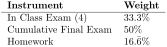
The commonality between these two groups in a WAG course is often a grade of C. In the SBG courses, we expect the students in the former category move up, while the latter category moves down, accounting for much of the movement away from a final grade of C. The capable students who struggle at the beginning of the course are often determined to improve, regardless of the grading scheme, and are rewarded in the SBG course with a grade that reflects this effort. However, the student who would normally pass on the basis of partial credit alone will typically fail the course if he or she approaches it the same as a WAG course. From our perspective, the behavioral aspect of failure lies partially with student motivation and partially with buy-in [14].
In particular, we have observed a subset of students — especially in general education courses — who seemingly refuse to use the reassessment mechanism to improve content knowledge. Indeed, these students make a mistake on the first attempt at a standard and, rather than use the mistake to grow, continue to make the same mistake on future reassessments. While we have attempted to rectify this phenomenon using frequent reminders about the need to remediate past mistakes and available resources for doing so ( office hours, tutoring centers, etc.), some students appear unmoved by our efforts to persuade them.
Additionally, we believe some of the growth in failing grades (D and F) can be attributed to a phenomenon we have dubbed “False Hope” that occurs at the deadline to withdraw from a course. In the traditional WAG course, under-performing students can use Figure 6.1 to come to the realization that it has become mathematically impossible to pass the course and subsequently withdraw. However, the structure of SBG provides a student in a similarly grim situation a glimmer of hope that he or she can radically change his or her behavior and finish the course with a passing grade. This comeback rarely comes to fruition due to the substantial number of standards the student must master on the remaining assessments. While we tell our students plainly that this type of comeback is highly improbable, some portion remain undeterred.
The second noteworthy trend that we observe is a pronounced improvement of SBG students in the follow-up math course compared to their peers in WAG courses. Particularly, the percentage of students earning a grade of A or B is significantly higher for students having taken the SBG College Algebra course than for those having taken the WAG College Algebra course, while the percentage of students earning a grade of C is significantly lower for students having taken the SBG College Algebra course than for those having taken the WAG College Algebra course. This appears to provide preliminary evidence to support anecdotal claims in the literature that students in SBG courses earn grades that more accurately reflect student knowledge [9] [4] and learn concepts at a deeper level than their peers in WAG courses [10] [11] [12]. This suggests the need for a carefully designed longitudinal study of outcomes for students in SBG courses to confirm these hypotheses.

